TIZE- a professional custom pet products manufacturer and dog training device supplier since 2011.
Language
Pet hair can cling to clothing, sofas, bedding, and car seats, but not every hair-removal tool works the same way. A sticky lint roller uses an adhesive surface to pick up loose fur, while a reusable pet hair remover roller typically relies on a reusable surface or collection mechanism instead of disposable adhesive sheets. Sticky rollers are often convenient for quick clothing cleanup; reusable rollers may be more practical for frequent cleaning of suitable fabric surfaces.
Choosing between a reusable pet hair remover roller and a sticky lint roller depends on the type of pet hair, the surfaces you need to clean, and how often you use it. In this guide, we compare how both tools work, their pros and cons, cleaning performance, and long-term costs. Whether you're a pet owner looking for an effective way to remove fur from furniture and clothing or a retailer sourcing reusable pet hair removers for resale, you'll learn how to choose the right option for your needs.
A sticky lint roller usually consists of a handle and a roll of adhesive-coated sheets. As the roller moves across a surface, the adhesive picks up loose pet hair, lint, dust, and small fibers. When the sheet becomes covered or loses its tack, the user peels it away to reveal a fresh layer.
Many products marketed as disposable lint rollers have a reusable handle but use replaceable adhesive sheets. The handle may last through many uses, while the adhesive material is consumed over time. Refill availability, sheet count, adhesive strength, and roll width vary by product.
· Quick and straightforward: useful for removing loose hair from clothes before leaving home.
· Portable: many designs are small enough to keep in a bag, car, or office.
· No collection chamber to empty: used adhesive sheets can be peeled off and discarded.
· Ongoing consumable use: frequent cleaning may require regular purchases of replacement rolls.
· Large surfaces may take more sheets: cleaning a sofa or bedding area can use adhesive material quickly.
Sticky lint rollers are a practical choice when convenience and quick cleanup matter most. Their long-term cost depends on usage frequency, how many sheets each task requires, and replacement-roll prices.
Reusable pet hair remover rollers come in different designs. Some use a reusable textured surface to gather hair; others use a rolling mechanism that moves collected fur into an internal compartment. The exact cleaning method and maintenance steps depend on the model, so buyers should check the product instructions rather than assume every reusable roller works in the same way.
Unlike an adhesive roller, a reusable roller generally does not need a new sticky sheet for each cleaning session. Hair may need to be removed from a collection chamber or from the tool's surface after use.
· No repeated adhesive-sheet replacement: useful for people who clean pet hair frequently.
· Can suit repeated cleaning: depending on design, it may be convenient for suitable sofas, bedding, and other fabric surfaces.
· Potentially less disposable-sheet waste: it can reduce reliance on single-use adhesive sheets.
· Requires maintenance: users may need to empty a chamber or clean the roller after use.
· Performance varies by surface: results depend on tool design, fabric texture, and how deeply the hair is embedded.
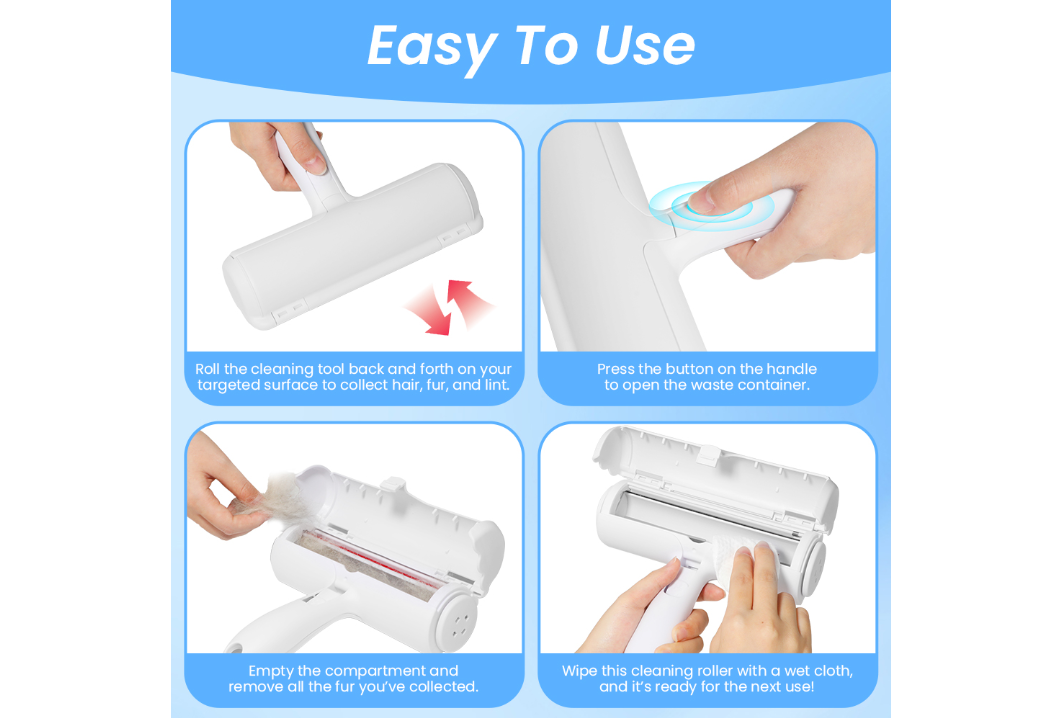
For example, the ChomChom Roller is a recognizable reusable pet hair removal product that uses a rolling mechanism to collect fur for disposal. For retailers, importers, and e-commerce brands looking to source similar reusable pet hair removal products, TIZE offers the P0053 reusable pet hair remover roller for wholesale and private-label opportunities. This pet hair remover roller upgrades five core engineering: Built with high-density ABS material, durable dual wheels, reinforced cover buckles, a thicker rubber squeegee, and a robust spring-lock button for smooth fur collection.
Buyers can explore the TIZE P0053 reusable pet hair remover roller to review product details and contact TIZE about wholesale orders, samples, and available customization options.
A sticky lint roller removes pet hair with adhesive sheets that are peeled off and replaced after use. A reusable pet hair remover roller collects fur through a reusable rolling surface or collection mechanism, depending on the design. The main differences are consumables, cleaning performance, maintenance, and long-term cost.
| Comparison Factor | Sticky Lint Roller | Reusable Pet Hair Remover Roller |
| How It Works | Uses adhesive sheets to pick up loose pet hair, lint, and debris from surfaces. | Uses a reusable rolling surface or collection mechanism to gather pet hair, depending on the product design. |
| Consumables | Requires replacement adhesive sheets as they become full or lose effectiveness. | Typically does not require disposable adhesive sheets. |
| Best For | Quick cleanup of pet hair on clothing, coats, and small fabric areas. | Repeated pet hair removal from suitable furniture, upholstery, and other compatible fabric surfaces. |
| Cleaning Performance | Convenient for loose hair and quick touch-ups; performance depends on adhesive quality and the surface. | Can collect loose and embedded fur from compatible fabrics; results depend on the roller design, fabric texture, and hair type. |
| Large-Area Cleaning | May require multiple adhesive sheets when cleaning large furniture or heavily fur-covered surfaces. | Can be practical for repeated cleaning of larger compatible surfaces without changing adhesive sheets. |
| Maintenance | Peel off and discard the used adhesive sheet when it becomes full or less effective. | Empty the collection chamber or clean the roller according to the manufacturer's instructions. |
| Portability | Many models are compact and easy to carry for travel or clothing touch-ups. | Portability depends on the product's size, shape, and cleaning mechanism. |
| Long-Term Cost | Ongoing costs depend on the initial price and how frequently replacement sheets are purchased. | Ongoing costs depend on the initial price, durability, and any cleaning or replacement requirements. |
| Waste Considerations | Used adhesive sheets create recurring disposable waste. | Can reduce waste from disposable adhesive sheets, although the overall environmental impact depends on product materials and lifespan. |
| Key Buying Consideration | Best suited to buyers who prioritize quick cleanup and easy disposal. | Best suited to buyers who want a reusable tool for frequent pet hair removal on compatible surfaces. |
In general, a sticky lint roller is often the more convenient choice for quick cleanup on clothing and small areas. A reusable pet hair remover roller may be more practical for repeated cleaning of compatible furniture and upholstery because it does not rely on disposable adhesive sheets. Neither option works equally well on every surface, so the best choice depends on the fabric, the type and amount of pet hair, and how frequently the tool will be used.
A sticky lint roller is often a convenient option for loose hair on clothing because it is easy to carry and use for a quick touch-up. Results depend on adhesive quality and fabric. For delicate materials, follow garment and product care instructions and test in an inconspicuous area first.
For repeated cleaning of a sofa or upholstered furniture, a reusable roller may be convenient because it does not rely on a fresh adhesive sheet for each pass. Check whether the product is designed for the upholstery in question and follow the manufacturer's directions. The TIZE P0053 reusable pet hair remover roller is one product option to review.
Bedding and blankets can collect loose fur across a relatively large area. A reusable roller may be useful for regular maintenance, while a sticky roller can help with smaller areas or last-minute cleanup. The best option depends on fabric weave, hair type, and how much fur has accumulated. Always check care instructions before using a tool on delicate bedding.
Carpets and textured upholstery can hold hair between fibers, so a roller that works well on a smooth jacket may not perform the same way on a car seat or rug. Depending on the surface, a manual rubber pet hair remover may be another option. Its edge or textured surface can help gather hair on compatible materials, but users should test gently first and follow product instructions.
For buyers comparing tools for upholstery, carpets, and car interiors, see the TIZE R131 manual pet hair removal tool. It is a rubber-edge scraper-style tool rather than a lint roller, so it should be evaluated as a separate cleaning option.
· Loose hair on clothes — Sticky lint roller: convenient for quick, portable cleanup.
· Frequent cleaning of suitable sofas or bedding — Reusable pet hair remover roller: avoids repeated adhesive-sheet replacement.
· Hair on certain textured upholstery or carpets — Manual rubber pet hair remover: may help gather hair from compatible surfaces.
· Travel or occasional use — Compact sticky roller: often easy to carry and use on the go.
· Several different surfaces at home — Consider a combination of tools because different surfaces may need different cleaning methods.
A sticky lint roller may have a low initial price, but users who clean pet hair frequently should also consider the cost of replacement sheets. A reusable roller may reduce the need for disposable adhesive sheets, but its value depends on purchase price, durability, maintenance requirements, and cleaning performance.
For frequent cleaning, a reusable design may be worth considering because it avoids repeated adhesive-sheet replacement. For occasional use or quick clothing touch-ups, a sticky lint roller may be more convenient. To compare costs fairly, consider how often the tool will be used, the number of sheets consumed per task, refill prices, and the expected useful life of the reusable product.
Avoid assuming that every reusable product is automatically cheaper or more sustainable in every situation. A fair comparison should consider actual product construction, durability, maintenance, and usage patterns.
· Start with the surface you clean most often. Clothing, upholstery, bedding, carpets, and car interiors may require different tools.
· Consider cleaning frequency. Frequent cleaning may make a reusable design more convenient; occasional cleanup may favor a compact sticky roller.
· Check maintenance requirements. Understand whether the tool needs replacement sheets, a collection chamber emptied, or a surface cleaned.
· Consider fabric compatibility. Follow product instructions and test delicate materials in a small, inconspicuous area.
· Think about portability and storage. A compact sticky roller may suit travel, while a larger reusable tool may be more practical for home use.
If a household has several types of surfaces, using more than one tool may be more practical than expecting a single product to handle every cleaning task.
The best pet hair remover for an individual household may not be the best product for every retail channel. For importers, Amazon sellers, and pet stores, product selection also depends on the target customer, selling price, product positioning, packaging, and expected repeat-purchase behavior.
Importers and distributors may want to compare several product types rather than rely on a single format. Consider the target market, retail price positioning, packaging dimensions, product durability, sample performance, order quantities, and supplier lead times. A balanced range could include quick-use sticky rollers, reusable rollers, and manual rubber hair-removal tools for different customer needs.
E-commerce sellers should assess how clearly a product's use and benefits can be explained in listing images and copy. Before committing to a bulk order, test samples on the surfaces described in the listing and document realistic use cases. Also review packaging size, product consistency, customer instructions, and the risk of claims that cannot be substantiated. Product differentiation should be based on real features and verified performance rather than exaggerated promises.
Pet stores can consider positioning sticky rollers as convenient everyday accessories, reusable rollers as repeat-use household cleaning products, and rubber pet hair removers as an option for certain upholstery or carpet-cleaning tasks. The right mix depends on local customer needs, shelf space, price points, and how the products complement the store's existing pet-care range.
For a broader product selection, explore TIZE's pet grooming and cleaning tools category.
When evaluating a reusable pet hair remover wholesale supplier, buyers should look beyond unit price. Review product construction, material information, sample performance, packaging options, minimum order quantity, lead time, quality-control process, and communication during product development. Request written specifications and confirm which customizations are available before finalizing an order.
Brands and resellers looking for a private label pet hair remover supplier should confirm whether the supplier can support the required logo, colors, packaging, labels, and product presentation. Ask for samples before approving a design, and make sure final specifications, packaging artwork, quality requirements, and delivery schedule are documented.
TIZE offers pet hair-removal products including the R131 manual pet hair removal tool and the P0053 reusable pet hair remover roller. Importers, retailers, and e-commerce brands can review the product pages and contact TIZE to confirm current MOQ, sample availability, customization options, pricing, and lead times.
If you are planning a new pet-care range, share your target market, sales channel, preferred product type, and estimated order quantity when requesting a quote. This helps the supplier recommend a product configuration and purchasing plan that fits your business requirements.
Explore TIZE Pet Grooming & Cleaning Tools
Not in every situation. A sticky lint roller is often convenient for quick cleanup on clothes and small areas, while a reusable pet hair remover roller may suit frequent cleaning of larger, compatible surfaces. The best option depends on fabric, hair type, cleaning frequency, and product design.
Many reusable pet hair removers collect fur through a reusable surface, rolling mechanism, or hair-collection compartment rather than disposable adhesive sheets. Designs vary, so check how the specific product works and how it should be cleaned.
Yes. Sticky lint rollers can be useful for removing loose dog and cat hair from clothing and other suitable surfaces. For large areas, frequent use may require multiple adhesive sheets.
Some reusable rollers are suitable for certain upholstery, but compatibility depends on the tool and material. For car seats or textured fabric, check product instructions and test gently in an inconspicuous area.
It can be, particularly for frequent use, because it may reduce spending on replacement adhesive sheets. However, the comparison depends on purchase price, durability, maintenance, refill costs, and how often the tool is used.
You can find suppliers on B2B platforms such as Alibaba and Made-in-China.com, through Google searches for "reusable pet hair remover wholesale supplier," or by using AI tools like ChatGPT and Google AI Mode. Compare product quality, MOQ, lead times, samples, and OEM or private-label options before placing a bulk order.
For a sticky lint roller, peel off the used adhesive sheet to expose a fresh layer. If all sheets are used, replace the refill. For reusable rollers, clean accumulated fur and debris according to the manufacturer's instructions.
You can use a reusable pet hair remover roller, a rubber glove, a rubber-edged pet hair remover, or a vacuum with an upholstery attachment. Choose the tool based on the surface and type of pet hair.
Remove collected fur from the collection chamber or cleaning surface, then follow the manufacturer's cleaning instructions. Only wash the roller if the product is designed to be washable.
A sticky lint roller is often a convenient choice for quick, portable cleanup. A reusable pet hair remover roller may be more practical for frequent cleaning of suitable fabric surfaces, while a manual rubber pet hair remover can be a useful additional option for certain textured upholstery and carpets. No single tool is best for every surface, so consider the type of hair, fabric, cleaning area, and maintenance requirements before choosing.
For importers, Amazon sellers, and pet stores, a well-planned product range can address different cleaning needs and price points. Compare product samples, confirm specifications, and evaluate supplier capabilities before placing a wholesale order. TIZE's R131 and P0053 product pages provide starting points for buyers comparing manual rubber tools and reusable rollers.
Recommended
TIZE, founded in 2011 and based in Shenzhen, China, is a professional OEM/ODM manufacturer and supplier of a variety of dog training devices, LED dog collars, pet leashes and harnesses, pet trackers, cat water fountains, and dog chew toys, etc.