TIZE- a professional custom pet products manufacturer and dog training device supplier since 2011.
Language
As global demand for smart pet products continues to rise, the technology behind pet containment systems is undergoing a quiet revolution. Traditional GPS-based fences—once the dominant solution—are now being challenged by a new contender: UWB (Ultra-Wideband) wireless pet training systems.
For OEM brands, distributors, and wholesalers in the pet electronics industry, understanding this technological shift is crucial. The choice between GPS and UWB pet fence systems determines not only the accuracy and reliability of your next product line, but also your competitiveness in the fast-evolving smart pet market.
This article provides a technical yet practical comparison between UWB and GPS smart wireless fence systems, outlining their working principles, strengths, limitations, and commercial implications—backed by TIZE's latest engineering insights.
Global Positioning System (GPS) fences use satellite signals to create virtual boundaries. When a pet wearing the GPS collar crosses this boundary, the system sends alerts or correction signals.
● Wide coverage—ideal for open outdoor spaces
● Mature, low-cost technology
● Easy to integrate into existing devices
● Accuracy typically ranges from 3–10 meters
● Signal quality affected by buildings, weather, and terrain
● High latency makes real-time control challenging
Ultra-Wideband (UWB) operates on high-frequency short pulses, measuring distance through Time of Flight (ToF) between transmitter and receiver. Instead of relying on satellites, UWB uses local anchor points or communication between collar and base station to define zones.
● Centimeter-level accuracy (±10–30 cm)
● Real-time response with ultra-low latency
● Strong anti-interference performance
● Works reliably indoors and outdoors
● Higher chipset and calibration cost
● Shorter effective range (typically up to 50 meters per base)
| Aspect | UWB (Ultra-Wideband) | GPS (Global Positioning System) |
| Accuracy | ±10–30 cm (centimeter-level) | 3–10 m (meter-level) |
| Signal Stability | Works well indoors/outdoors; strong anti-interference | Easily disrupted by obstacles, buildings, or weather |
| Latency | Instant response (<100 ms) | Delayed feedback (up to several seconds) |
| Coverage Range | Ideal for 5–50 m | Suitable for wide areas but less precise |
| Power Consumption | Moderate | Variable depending on satellite signal |
Setup Complexity | Simple and local calibration | Requires satellite lock and signal optimization |
| Cost | Slightly higher | Lower but less advanced |
Ideal Use Case | Home yards, training zones, precise control | Large outdoor tracking areas |
For residential use or small training spaces, UWB systems offer a clear advantage. GPS signals often weaken indoors or near buildings, leading to inconsistent boundaries. UWB, on the other hand, maintains precise detection—even through partial obstructions—allowing for consistent pet safety zones.
GPS still excels when it comes to long-distance tracking, such as open fields or hiking scenarios. However, its margin of error makes it unsuitable for applications requiring real-time boundary alerts.
Latency is critical when training multiple pets simultaneously. UWB systems can deliver instant correction signals without delay, offering trainers and owners precise behavioral control. GPS devices, due to satellite delay, cannot match this real-time responsiveness.
When evaluating technology for your next pet fence product, cost should not be viewed in isolation. While UWB modules are initially more expensive than GPS, the value-to-performance ratio is significantly higher.
● User experience: centimeter-level precision enhances customer trust and satisfaction
● Product differentiation: fewer competitors currently adopt UWB, giving early adopters a strong brand advantage
● Long-term ROI: as UWB chipsets scale, costs continue to decline while precision and energy efficiency improve
From a business perspective, investing in UWB-based smart fences now allows OEM and ODM brands to lead in the premium market segment rather than compete on price alone.
TIZE, a professional pet electronics manufacturer, has launched the TZ-F383 3-in-1 Dog Fence Training System, representing the next leap in wireless containment technology.
Key Highlights:
● Combines three functions in one: wireless fence, remote training, and anti-loss system
● Utilizes UWB-level precision for accurate “keep-in” and “keep-out” zones
● Supports up to three dogs simultaneously with adjustable intensity levels
● Equipped with a 3000mAh remote battery and Type-C fast charging
● Fully CE/FCC certified, supporting OEM and ODM customization
This product exemplifies TIZE's dedication to integrating engineering innovation with practical design—helping partners deliver smarter, safer, and more competitive pet solutions.
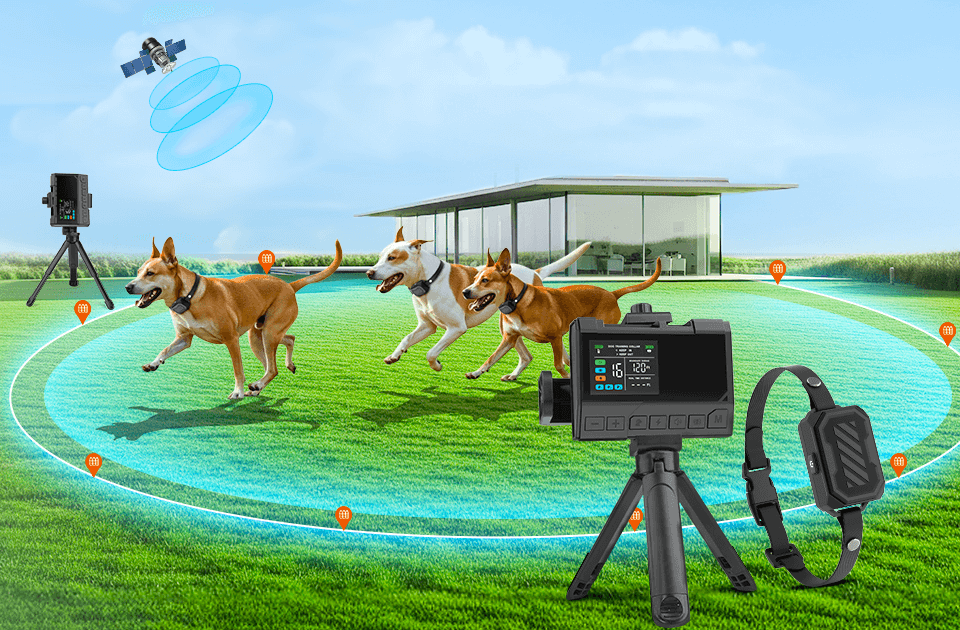
As consumer expectations rise, UWB's precision and reliability are setting new standards for the pet containment industry. Future systems may integrate AI-driven behavioral recognition, multi-zone adaptive fencing, and real-time health monitoring—all powered by UWB infrastructure.
For OEMs and distributors, early adoption is key. Aligning your product line with next-generation standards today positions your brand for sustained growth in tomorrow's intelligent pet market.
Choosing between UWB and GPS is more than a technical decision—it's a strategic one.
● GPS remains relevant for basic, wide-area tracking.
● UWB, however, defines the next era of precision-driven, intelligent pet management.
By integrating UWB technology into your upcoming product line, you not only enhance functionality but also elevate your brand's reputation for innovation and reliability.
Partner with TIZE to integrate next-generation UWB precision fencing into your OEM or wholesale lineup.Contact us today to explore customization opportunities. © TIZE — Leading Innovation in Smart Pet Electronic
Recommended
TIZE, founded in 2011 and based in Shenzhen, China, is a professional OEM/ODM manufacturer and supplier of a variety of dog training devices, LED dog collars, pet leashes and harnesses, pet trackers, cat water fountains, and dog chew toys, etc.