TIZE- a professional custom pet products manufacturer and dog training device supplier since 2011.
Language
Barking is a normal way for dogs to communicate. However, excessive barking can affect the quality of life for both the owner and neighbors. This article will introduce 6 useful anti-barking tools in detail to help you choose the best solution and make your dog quieter and more well-behaved.
Before introducing the specific tools, it's important to understand the core principles of each product. The right choice needs to take into account the dog's size, temperament, and the specific reasons for barking. Now, let's learn about the features and suitable scenarios of these tools in detail.
The vibration anti-barking collar uses advanced vibration feedback technology. When it detects the dog barking, it will give a gentle sound and vibration reminder. The vibration intensity is usually adjustable, ranging from a slight touch to a noticeable vibration. It interrupts the dog's barking behavior through physical stimulation, without causing pain or harm. It is especially suitable for sensitive dogs and owners who are using anti-barking tools for the first time.
The electric shock anti-barking collar stops barking through microcurrent stimulation. It is one of the most effective anti-barking products. Modern electric shock collars use a progressive stimulation system, which will automatically adjust the current intensity according to the number of barks. However, it should be noted that this kind of product is quite controversial. Improper use may cause anxiety or fear in dogs. It is recommended to use it only under the guidance of a professional dog trainer.
The ultrasonic collar is an innovative product in recent years. It uses advanced sound wave technology. When a dog barking triggers the device, it will immediately emit high-frequency ultrasonic waves (usually between 25-30kHz) that are inaudible to humans. This frequency is just in the most sensitive range of a dog's hearing and will produce a slight discomfort, thus interrupting the barking behavior. Compared with physical stimulation methods, ultrasonic waves are more gentle and contact-free, and are especially suitable for breeds that are sensitive to tactile stimulation.
This is an independent intelligent anti-barking device that can be placed anywhere in a room or yard. When the built-in high-sensitivity microphone detects the dog barking, the device will immediately emit an ultrasonic pulse with an effective range of 5-15 meters (such as TIZE ultrasonic bark control device). Some high-end models can adjust the ultrasonic frequency. This device is particularly suitable for families with multiple dogs or situations that need to cover a larger area, and no device needs to be worn by the dog at all.
This portable training tool looks like a TV remote control. It uses precise directional sound wave technology. When the dog barks improperly, the owner just needs to press the button, and the device will emit a directional ultrasonic beam with an effective range of about 5-7 meters. Advanced models have adjustable frequency functions that can be adjusted to the most suitable sound wave frequency for different-sized dogs. Unlike automatic devices, the handheld version requires the owner to judge the timing of use. It is more suitable for training specific barking behaviors, such as overreaction to couriers, passers-by, etc.
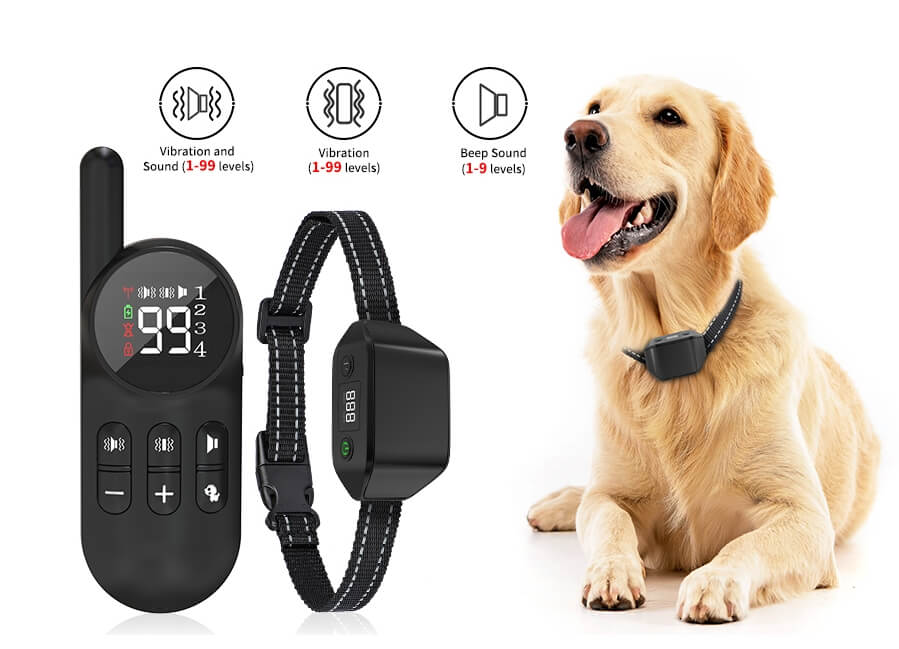
This is a multi-functional training system, usually consisting of a receiver worn by the dog and a transmitter held by the owner. It uses high-frequency radio technology to transmit control commands, with a control distance of more than 300 meters. When the owner presses the button on the remote control, the remote control will send a signal to the receiver (collar) worn by the dog.
After the receiver receives the signal, it will produce the corresponding stimulation according to the preset mode, such as electric shock, vibration or sound. The advantages are long transmission distance, good wall-penetrating effect, low power consumption and strong anti-interference ability. Professional dog trainers especially recommend this tool because it can not only correct barking, but also be used for recall training, stopping jumping and other behavioral corrections.

Choosing the right anti-barking tool depends on the specific usage scenario. Different living environments and reasons for barking require different solutions. Let's see what situations these tools are best suited for.
It is most suitable for urban apartment environments and small dogs. When the dog barks because of daily noises like doorbells or neighbors walking around, the vibration reminder can effectively interrupt this behavior. It is also suitable for training puppies during the training period to help them establish the right behavior habits. When used indoors, it is recommended to combine it with positive reinforcement training for more lasting effects.
It is mainly used for stubborn and severe nuisance barking problems, such as guard dogs with strong territorial awareness or dogs with long-term separation anxiety. This kind of product is very effective in places like farms and warehouses where strong barking needs to be stopped. However, the usage time must be strictly controlled. It is recommended not to wear it for more than 12 hours at a time and to closely observe the dog's reaction.
It is most suitable for suburban residences or homes with yards. It can effectively control the dog's alert barking to external stimuli (such as passing vehicles and pedestrians). It is also recommended for breeds that are sensitive to tactile stimulation, such as Chihuahuas and Poodles. When used in an apartment building, the sound insulation effect should be considered to avoid ultrasonic waves penetrating walls and affecting neighboring pets. In the early stage of training, it is suggested to combine it with positive reinforcement. After the ultrasonic wave is triggered, if the dog stops barking, give it a reward immediately.
It is particularly suitable for the following scenarios: families with multiple dogs; environments where the owner is often not at home; open areas such as yards or gardens. The device is best installed in the center of the area where the dog often stays, with a height of about 1-1.5 meters. When used indoors, it is recommended to test the trigger sensitivity in different positions first to avoid the effect of furniture blocking. Pay attention to regularly cleaning the microphone port to prevent dust accumulation from reducing the accuracy of identification.
It is mainly used for specific scenario training, such as barking when the doorbell rings, excited reaction when seeing other dogs, and fearful barking to specific sounds (such as thunder). When using it, it is important to grasp the timing. It is best to press the button within 0.5 seconds after the barking starts so that the dog can more easily establish a behavioral association. It is recommended to combine it with a unified command like "quiet" to gradually reduce dependence on the device. It is not suitable for anxiety-related barking without a clear cause.
It is most suitable for situations that require systematic behavioral correction. In addition to stopping barking, it can also be used for: stopping jumping on people, preventing car chasing, recall training, etc. It is widely used in professional dog training places and service dog training. When used at home, it is recommended to make a systematic training plan and have 15-20 minutes of special training at a fixed time every day at the beginning. Pay attention to gradually reducing the stimulation intensity according to the training progress, and finally transition to only using sound prompts or vibration mode.

The correct usage method directly affects the effectiveness and safety of the anti-barking tools. The following is a detailed introduction to the operation points of each product to help you achieve the best training effect.
Before using it for the first time, please read the instructions carefully. When wearing it, make sure the collar is in good contact with the dog's neck skin. If it is too loose, it will affect the induction, and if it is too tight, it will cause discomfort. It is recommended to start from the lowest level and adjust the intensity according to the dog's reaction. In the early stage of use, it is recommended to combine it with the "quiet" command training. When the dog stops barking, give it a snack reward to reinforce positive behavior.
Before using it, you must consult a professional dog trainer. It is recommended to test it under supervision for the first time, starting from the lowest current intensity. The usage time should not be too long each time, and it is best to control it within 4-6 hours. Pay special attention to the dog's reaction. If abnormal behaviors such as excessive fear or increased aggressiveness occur, stop using it immediately. It is recommended to combine it with behavioral correction training to gradually reduce dependence on electric shock.
Before using it for the first time, let the dog get familiar with the existence of the collar first. On the first day, just wear it without turning on the function. On the second day, turn on the detection mode but do not emit ultrasonic waves. On the third day, start formal training. The daily usage time is recommended to be controlled within 8 hours to avoid the dog getting used to it. Regularly clean the sensor contact points with a soft cloth to ensure the detection sensitivity. When changing the battery, pay attention to the positive and negative polarity. Incorrect installation may cause functional abnormalities.
When installing, choose a place 3-5 meters away from where the dog often stays, and avoid pointing directly at the resting area. It is recommended to start with the lowest sensitivity when using it for the first time. Observe for 1-2 days and then adjust gradually. Check the microphone sensitivity once a week. You can test the reaction speed with a simulated dog bark. When used in a multi-dog family, it may be necessary to set different recognition frequencies for each dog (only supported by high-end models). Pay attention to the working temperature range of the device and avoid using it in extreme weather.
Before using it, test the effective distance first. Press the button in different positions and observe the dog's reaction. When training, maintain a calm attitude and avoid using it when emotionally agitated. It is recommended not to use it continuously for more than 3 times of stimulation, as excessive use may cause the dog to develop tolerance. Regularly check the battery power. When the battery is low, the ultrasonic frequency may shift and affect the effect. Store it in a place away from high temperature and humidity to prevent circuit damage.
Before using it for the first time, it is recommended to let the dog get familiar with the existence of the receiver first. When training, start with the mildest mode (usually sound prompt) and gradually transition to vibration mode. The electric shock mode should be used as a last resort and must be used under the guidance of professionals. Each training session should be controlled within 15 minutes, and no more than twice a day. Remove the receiver in time after training to avoid discomfort from long-term wearing. Regularly check the conductivity of the contact points and maintain them with a special cleaner if necessary.
To use these tools safely, the following precautions need to be paid special attention to, to ensure that they can effectively stop barking without harming the dog's physical and mental health.
Avoid wearing it continuously for 24 hours. It is recommended not to use it for more than 12 hours a day. Regularly check the skin condition of the wearing part to prevent friction damage. Do not use it near water, as most products are not waterproof. If the dog shows skin redness or abnormal behavior, stop using it immediately and consult a veterinarian. It is recommended to take it off every 2 hours and let the skin rest for 30 minutes.
It is strictly forbidden to use it for puppies under 6 months old, pregnant bitches or dogs with heart problems. Make sure the battery power is sufficient before using it to avoid unstable current causing harm. Never use the electric shock function as a punishment tool at will. If the dog shows excessive stress reactions, such as hiding, loss of appetite, etc., stop using it immediately and seek professional help.
Avoid using it in a noisy environment (such as near a construction site), which may cause frequent false triggering. Do not wear it with other metal collars at the same time, which may interfere with signal transmission. The effect may be poor for elderly dogs with hearing impairment. If the dog frequently shakes its head or scratches the collar during use, it may be due to improper ultrasonic frequency. Adjust or suspend use in time. Pay attention to waterproofing during the rainy season, as most products only have splash-proof function.
The installation position should avoid continuous noise sources such as air conditioner outlets and fans. When used in a multi-pet family, observe the reactions of other animals (such as cats), and adjust the placement position if necessary. Remove the battery when the device is not used for a long time to prevent battery leakage from damaging the circuit. Avoid installing the device on a metal surface, which may affect the propagation of ultrasonic waves.
Do not aim it directly at the dog's ears when using it, and keep at least a 1-meter distance. Avoid overusing it in a small enclosed space, which may cause enhanced sound wave reflection and stimulation intensity. Pay attention to the dog's reaction. If the dog shows excessive fear, hiding and other behaviors, stop using it immediately and consult a professional. Keep the device out of reach of children to prevent accidental operation.
It is strictly forbidden to use it as a punishment tool at will. It must be used strictly according to the training regulations. Make sure the dog is healthy before using it, and be especially careful with dogs that have a history of heart disease. Ensure the dog has sufficient drinking water and rest time during training. If skin irritation or abnormal behavior is found, stop using it immediately and seek medical attention. Different brand receivers may have frequency conflicts. It is recommended to use the same brand in a multi-dog family. Regularly check the sensitivity of the remote control buttons to prevent accidental triggering.

A comprehensive understanding of the pros and cons of each tool can help you make a wiser choice. Here is a detailed analysis:
Pros: It uses the gentlest intervention method, without causing pain or fear; it is easy to use and suitable for novice owners; most products are waterproof and suitable for outdoor use; it is relatively inexpensive.
Cons: It has limited effect on stubborn barking; some dogs may gradually get used to the vibration; it is not suitable for long-haired dog breeds (affecting sensor contact).
Pros: It works the fastest and can immediately interrupt severe barking; it can adjust the intensity to suit different-sized dogs; some high-end models have intelligent learning functions; the battery life is long.
Cons: It may cause psychological trauma; improper use may worsen behavioral problems; it requires professional guidance; it is expensive; there are moral disputes.
Pros: It is completely contact-free and one of the gentlest intervention methods; it does not cause pain or fear; it is suitable for dogs of all sizes; most products are waterproof and suitable for outdoor use.
Cons: It may fail in a noisy environment; some dogs may develop adaptability; it has limited effect on severe barking; it is not suitable for elderly dogs with hearing loss.
Pros: There is no need to wear any device, and the dog's acceptance is high; it covers a large area; it can work 24 hours a day; intelligent recognition reduces false triggering.
Cons: It may fail in a noisy environment; some dogs may develop adaptability; it is ineffective outside the effective range; it may interfere with other animals; high-end models are expensive.
Pros: Immediate intervention and precise control; no device needs to be worn; portable and easy to use; it can be used for specific behavior training; it can also be used as a safety device to drive away vicious dogs.
Cons: It completely depends on the owner's operation; it is ineffective outside the effective range; it needs to be carried with you.
Pros: It has a wide range of functions and can be used for multiple purposes; it can be operated remotely; the training mode is flexible and adjustable; it has professional-level training effects.
Cons: It requires training at the beginning; it is expensive; the risk of improper use is high; some dogs may have stress reactions.
In order to compare these anti-barking tools more intuitively, we have compiled a detailed comparison table. It is recommended to make a choice based on actual needs, taking into account all factors comprehensively.
| Tool | How It Works | Pros | Cons | Best For |
| Vibration Collar | Physical vibration | Safe, no pain | Some dogs ignore it | Mild barking |
| Shock Collar | Static shock stimulation | Works fast | May cause anxiety controversial | Last-choice option |
| Ultrasonic Collar | High pitched sounds | Contact-free, safe harmless | May stop working later | Medium barking |
Ultrasonic Device (Box) | Ultrasonic sound interference | No need to wear wide coverage | Can affect other pets | Fixed areas (e.g., yards) multi-dog families |
Handheld Ultrasonic | Directional ultrasonic waves | Flexible, controllable | Requires owner's operation | Specific barking cases temporary barking |
Remote Trainer | Vibration/Sound/Shock | Multi-function precise control | Needs training to use right | Advanced training comprehensive behavioral correction |
I hope this detailed guide helps you find the best way to solve your dog's barking problem. Remember, any anti-barking tool should be used with positive training. And you need to give your dog enough love and patience. If the problem still exists, it's a good idea to ask a professional dog trainer or animal behaviorist for help. I wish you and your dog a more harmonious life!
Recommended reading
Recommended
TIZE, founded in 2011 and based in Shenzhen, China, is a professional OEM/ODM manufacturer and supplier of a variety of dog training devices, LED dog collars, pet leashes and harnesses, pet trackers, cat water fountains, and dog chew toys, etc.