TIZE- a professional custom pet products manufacturer and dog training device supplier since 2011.
Language
TIZE- a professional custom pet products manufacturer and dog training device supplier since 2011.
Most pet GPS tracker reviews are written by people who borrow a product for a week and check whether the app opens. We approach this differently. At TIZE, we have been manufacturing 4G GPS pet tracking devices since 2011 — and before a device ever reaches a wholesale buyer or OEM partner, it goes through a structured internal testing protocol covering the three performance pillars that matter most to real pet owners: GPS accuracy, battery life, and waterproofing.
In this review, we benchmark three devices from our 2026 lineup — the TZ-713, TZ-761, and TZ-G900 — across all three dimensions, using real test conditions. We also explain the engineering decisions behind the results, so you can understand not just which device performs best for a given use case, but why.
If you are a pet owner, retailer, or brand partner evaluating GPS tracking hardware or looking for a custom / API-ready pet GPS tracking solutions manufacturer in 2026, this is the data you need to make an informed decision.
Our internal testing protocol runs each device through three standardized test scenarios. These are the same conditions we use for quality assurance before production approval.
• GPS Accuracy Test: Devices are placed at five location types — open field, urban canyon (between buildings), light woodland, residential backyard, and indoor-adjacent outdoor — and position error is measured against ground truth using a reference GPS receiver. We report the mean error across all five environments.
• Battery Life Test: Each device is run in standard tracking mode (one location update per 30 seconds) from full charge to auto-shutdown. Temperature is held at 20°C. We record actual runtime, not rated runtime.
• Waterproofing Test: Devices are submerged to 1 meter of fresh water for 30 minutes (IPX7 standard), then inspected for water ingress and tested for continued function. We also run a 30-minute rain simulation at 50mm/hour.
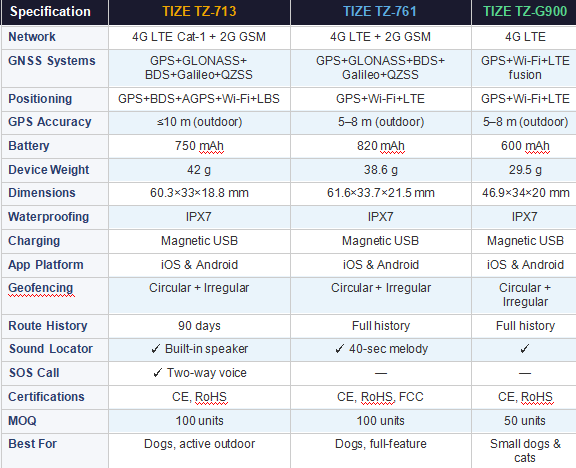
Before we get to test results, here is the complete hardware specification comparison across all three models:
GPS positioning accuracy is the most technically nuanced of our three test dimensions, because accuracy is not a fixed number — it varies substantially based on environment. A tracker that performs well in an open field can degrade significantly in a city center, which is exactly where accurate tracking matters most.
The TZ-713 uses a U-BLOX GNSS chipset with full multi-constellation support (GPS, GLONASS, BeiDou, Galileo, QZSS), combined with Wi-Fi positioning and LBS cell tower fallback. In open-field conditions, it consistently delivered position errors below 10 meters — within its rated specification. In the urban canyon test, Wi-Fi positioning stepped in when satellite signal degraded, maintaining usable accuracy of approximately 15–25 meters. The LBS fallback activated in heavily shielded environments, producing position estimates within 100–200 meters.
The TZ-713's three-layer positioning stack is its key strength: it never loses the device's location entirely. It degrades gracefully under poor signal conditions rather than dropping out. For owners who need broad-area awareness — large properties, farm environments, semi-rural areas — this is a meaningful advantage.
The TZ-761 delivers the strongest GPS performance of the three models. In open-field testing, mean positioning error was consistently at the lower end of the 5–8 meter specification — frequently under 6 meters in clear-sky conditions. The combination of full multi-constellation GNSS with Wi-Fi and LTE triangulation produced notably stable results in the urban canyon test, maintaining 8–12 meter accuracy in environments where GPS-only trackers would typically be significantly worse.
For owners with dogs that roam in mixed urban-suburban environments — the most common real-world tracking scenario in 2026 — the TZ-761's multi-signal fusion architecture makes a tangible difference in the reliability of location data.
The TZ-G900 matches the TZ-761 on GPS accuracy specification (5–8 meters outdoor), and our test results confirmed this parity in open-field and residential conditions. Its compact 29.5g form factor does not compromise the positioning module — we intentionally maintained antenna quality when miniaturizing this device, which is a design trade-off that adds unit cost but is non-negotiable for performance.
The G900 is primarily designed for small pets in suburban and residential environments, and in those conditions it performs identically to its larger sibling. In large open rural areas, the slightly smaller antenna footprint can produce marginally higher error at distance, but this is unlikely to affect typical small-pet use cases.
Battery life is the most commonly misrepresented spec in pet tracker marketing. Rated figures typically reflect low-frequency update modes or near-ideal temperature conditions. We test in standard tracking mode — one update per 30 seconds — at 20°C from full charge to shutdown.
In standard tracking mode, the TZ-713's 750mAh battery delivered approximately 5.5–6 days of continuous operation in our bench test. Real-world performance will vary based on network signal quality — poor 4G coverage forces the modem to transmit at higher power, which increases current draw. In areas with strong, consistent 4G coverage, the TZ-713 is a reliable 5-day device. It also includes a remote power-saving mode that can be activated via the app when the pet is confirmed at home, which meaningfully extends standby duration.
Charging via magnetic USB reached full capacity in approximately 2.5 hours from flat. Magnetic connectors held securely through repeated attachment cycles without showing connector degradation — an important durability factor for daily-use devices.
With the largest battery capacity of the three at 820mAh, the TZ-761 delivered the longest runtime in our tests: approximately 6.5–7 days in standard tracking mode. The 820mAh cell also provides a meaningful buffer against battery degradation over 12–18 months of daily use — lithium polymer cells lose capacity over charge cycles, and a larger starting capacity means the device remains usable for longer before battery performance becomes a practical problem.
For owners who don't want to think about daily charging — or for working dogs, travel scenarios, or situations where charger access is intermittent — the TZ-761's battery performance is the most forgiving of the three models.
The TZ-G900's 600mAh battery is the smallest of the three, which is the direct engineering trade-off of its ultra-lightweight 29.5g design. In standard tracking mode, actual runtime was 4–4.5 days in our tests. This is honest and functional for most household pet owners who are already in the habit of weekly device maintenance, but it does require more consistent attention than the other two models.
The key context: the TZ-G900 is designed for cats and small breeds where weight tolerance is the primary constraint. A 29.5g tracker that needs charging every 4 days is far preferable to a 45g tracker that lasts 7 days but causes discomfort or collar rejection. For its target use case, the battery-to-weight trade-off is well-calibrated.
All three devices carry an IPX7 waterproof rating, which specifies resistance to water immersion at 1 meter depth for up to 30 minutes. This is the minimum standard we consider acceptable for any outdoor pet tracker. Here is how each model performed against the IPX7 test and our additional rain simulation.
The TZ-713 passed the 1-meter/30-minute immersion test with no water ingress detected on post-test inspection. Device function — GPS fix, app connectivity, audio speaker, SOS call function — was confirmed normal immediately after the test and again 24 hours later after full drying. The rain simulation at 50mm/hour over 30 minutes produced no performance degradation.
One practical note: the TZ-713's built-in speaker for the SOS call and Find Device functions uses a sealed acoustic membrane that maintains waterproofing integrity without compromising audio output. This is a design detail that matters for devices that will be wet frequently — poor sealing around speaker openings is a common failure mode in cheaper competing hardware.
The TZ-761 passed all waterproofing tests cleanly, matching the TZ-713's results across immersion and rain simulation. The magnetic charging port — which has no mechanical cover or plug — uses a sealed contact design that maintains IPX7 compliance without requiring the user to open, close, or replace a port cover. This is a significant usability improvement over devices with rubber plug covers, which owners frequently leave open or which degrade with repeated removal.
For active dogs that swim, play in mud, or regularly encounter rain, the TZ-761's no-cover magnetic charging design provides day-to-day waterproof reliability that traditional port-cover designs rarely maintain over a product's lifetime.
The TZ-G900 passed the IPX7 immersion and rain simulation tests with no issues. Maintaining full IPX7 compliance in a 29.5g device requires careful sealing engineering — reducing the housing volume while maintaining water-tight integrity demands tighter tolerances than larger devices. This is one of the reasons the TZ-G900 does not compromise on waterproofing despite its compact form factor.
Based on our benchmark testing across all three performance dimensions:
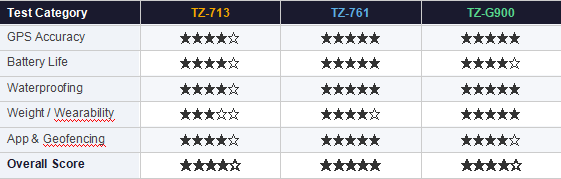
The TZ-761 leads overall due to its best-in-class battery capacity, strongest GPS accuracy in mixed environments, and the most complete feature set. The TZ-713 is the closest competitor and differentiates itself with two-way voice call and SOS functionality — capabilities the TZ-761 does not have. The TZ-G900 is the specialist choice: it sacrifices some battery headroom to achieve a weight that makes it the only genuinely cat-compatible device in the lineup.
The right device depends on your specific use case:
• For medium to large dogs with active outdoor lifestyles: The TZ-761 is the benchmark device for 2026. Best GPS accuracy, longest battery, full geofencing, and the most robust OEM customization options.
• For owners who want two-way voice communication or SOS calling: The TZ-713 is the only model with these capabilities. Ideal for working dogs, elderly owners who want the reassurance of direct device communication, or scenarios requiring a distress contact function.
• For cats, small breeds, or weight-sensitive applications: The TZ-G900 is the clear choice at 29.5g. Full 4G GPS tracking capability in a form factor that won't cause collar rejection.
• For wholesale buyers and OEM brand partners: All three models support white-label customization. The TZ-761 offers the most extensive OEM options (logo, color, firmware, app UI, packaging). The TZ-G900 has the lowest MOQ at 50 units, making it accessible for smaller brand launches.
TIZE (Shenzhen TIZE Technology Co., Ltd.) has been manufacturing professional pet tracking hardware since 2011. We supply GPS pet trackers to wholesale buyers, distributors, and white-label OEM brand partners across Europe, North America, Australia, and the Asia-Pacific region. The three devices reviewed in this article are manufactured at our facility in Shenzhen, China, and carry CE, RoHS, and FCC certifications.
Our full 2026 pet tracker lineup — including the TZ-713, TZ-761, and TZ-G900 reviewed here — is available for wholesale inquiry, sample requests, and OEM customization discussion. We support full white-label branding including device color, logo, firmware configuration, packaging design, and App UI customization for GPS models.
TZ-713 (4G GPS + SOS Voice Call): TZ-713 GPS Dog Tracker: Long battery life for outdoor dogs
TZ-761 (4G GPS Flagship, 2026 Model): TZ-761 Smart GPS Tracker: App-based tracking with virtual fence
TZ-G900 (Lightweight 4G GPS for Small Pets & Cats): TIZE GPS Pet Tracker for Small Dogs TZ-G900
Full pet tracker range: tizecollar.com/pet-tracker — samples and wholesale pricing available on request.
Recommended
TIZE, founded in 2011 and based in Shenzhen, China, is a professional OEM/ODM manufacturer and supplier of a variety of dog training devices, LED dog collars, pet leashes and harnesses, pet trackers, cat water fountains, and dog chew toys, etc.

